watchmaking Technical knowledge of watch construction, mechanical watches, complications, VBA programmes, books, watch technologyr
Energie Bilanz mechanische Uhr

Hairspring calculation

The shape of the hairspring end curve has a significant influence on timekeeping. Bending the terminal curve alters the angle between the attachment point and the counting point — typically by 20° to 30° with a standard curve. Using parametric CAD calculation, these angular changes can be determined precisely. The dynamic graphic shown here is generated with a dedicated Excel®-based simulation tool, and the Excel Solver can be used to fine-tune the geometry for optimal performance. This gives watchmakers and developers a powerful, practical method to design and optimise hairsprings with engineering accuracy.
- 20 ° +20 ° - 50 ° +50 ° PP PP' PC PC' PA CE -4 -3 -2 -1 0 1 2 3 4 -4 -3 -2 -1 0 1 2 3 4 Aussenradius Doppelkurve Biegung PA -20° PA +20° PA -50° PA +50° PP PP' PC PC' PA CE Rücker Rücker 12 ° 35 ° PP' - PP=31.21 ° a = b - r =

Accuracy & Rate Behaviour

Mechanical watches never produce perfectly flat timing curves — and here’s why: Why does the rate diagram of a movement appear scattered? What causes amplitude fluctuations? Why do repeated measurements sometimes differ? The answer lies in the natural torque variation of the gear train. Depending on tooth count and profile, torque fluctuates 4–10% from tooth to tooth, and each tooth in the mainspring barrel acts over 160–240 seconds. These variations propagate through the wheel train to the escapement. Software tools such as KiSSsoft® allow precise calculation of these torque changes. When observed at the escape wheel, the resulting torque pattern closely mirrors the rate curve of the balance wheel.
The isochronism of the hairspring compensates for much of this fluctuation — but not all. For accurate assessment, timing measu- rements should be taken over at least 120 seconds to ensure a reliable average. Understanding these dynamics is essential for advanced regulation, chronometric optimisation, and precision testing.

Chronometer measurement

For precision measurement, my chronometer-tracking app (available in the Apple App Store for iOS) enables accurate monitoring of mechanical timepieces. The app evaluates chronometric performance according to official COSC standards, using METAS (Swiss Federal Institute of Metrology) time servers as a certified atomic-time NTP reference.

Surface Pressure and Friction Torques (Hertzian Contact Theory)

The included VBA tool for overall gear-train efficiency allows you to analyse and optimise a complete movement — including auto- matic winding systems. The program calculates and evaluates: Bearing clearances Pivot and pin diameters Friction torques Surface pressures Hertzian contact stress These analyses enable engineers and watchmakers to refine gear trains for maximum efficiency, low wear, and long service life.

Performance

The performance of a modern mechanical watch begins with precise engineering — from tooth geometry and escapement design to energy efficiency and friction behaviour. This section provides a solid foundation in these essential principles. The latest edition now includes enhanced VBA-based Excel® tools with graphics, input validation, and integrated help menus, making it easier than ever to understand and apply the mathematics of watch engineering. Process technologies have evolved rapidly in the watch industry. Innovations such as silicon components, laser machining, and laser sintering, combined with Six Sigma and lean-manufacturing methods, have significantly raised performance and reliability standards. These advancements are covered in detail in the new edition. Free downloadable exercises are available to support your learning. Simply click on the images to access the material.

Master Modern Watchmaking – From Theory to Industrial-Level

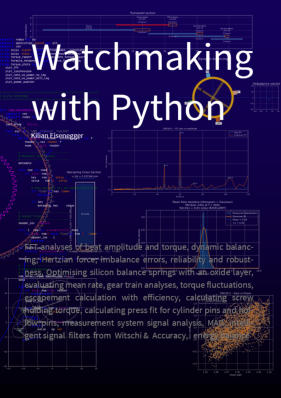
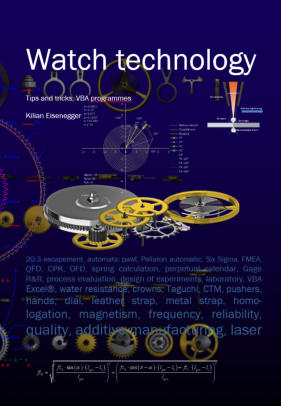
Unlock the engineering secrets behind precision watchmaking. This unique ebook and paperbooks provides a complete, professional-level journey through the design and industrial production of mechanical watches — from the first sketch to a fully functional automatic movement. Developed for watchmakers, engineers, and advanced enthusiasts, this book bridges traditional horological craftsmanship with modern engineering methods and production technologies.

What you will learn

Complete construction of a mechanical automatic movement Escapement selection and hairspring calculation Robust development workflows (Design for Six Sigma, Lean Manufacturing) Material & technology innovations (e.g., silicon components, laser micro-processing) Chronometry & precision optimization techniques Gear-train design & Hertzian pressure analysis for high efficiency and long life Quality systems to meet modern 10-year warranty standards Case and construction elements using state-of-the-art manufacturing processes With clear explanations, applied formulas, and ready-to-use Excel® calculation sheets, this book turns complex watch engineering into practical, actionable knowledge.

Why this book?

Unlike traditional watchmaking guides, this is not just theory — it is a modern engineering textbook for today’s horology industry. Whether you are refining your craft, entering the professional watch field, or seeking to innovate with new materials and processes, this resource gives you the technical foundation and industrial insight rarely found in one place.

Printed Edition – For Your Workshop or Library

Prefer a physical book? The complete watch-technology series is also available as premium paperback editions — perfect for hands-on reference, professional workshops, schools, and private horology libraries. The printed book is in black and white, while the e-book is in colour. Each volume delivers the same in-depth engineering insights as the e-book versions, with the advantage of large, high-quality printed diagrams and formulas for clear study and practical use at the bench. Order your paperback edition from trusted international book retailers: epubli.com — Direct publisher source (example: Watch Technology: ISBN 978-3-7598-7051-3) Amazon.de — Fast international delivery Lehmanns.de — Academic & technical bookstore Bring modern watch engineering to your desk — in book form, ready to study, annotate, and keep for years to come. Due to limited international distribution of the printed books, a full digital edition has been created. The e-book offers the same professional content with global availability and instant delivery.
Excel

Free VBA Tools for Watch Engineering

The detailed calculations required in modern watch construction can be performed quickly and accurately using Microsoft Excel®. All key formulas from Uhrenkonstruktion (Watch Construction) have been implemented as VBA functions, allowing you to apply them immediately in your own development work. The downloadable files have been revised and modernized, and include: Updated VBA functions for watch-engineering formulas Practical examples and ready-to-use calculation sheets Step-by-step instructions A comprehensive formula collection with exercises and solutions These tools make it easier to explore, understand, and apply precision watchmaking mathematics — whether you are learning, designing, or developing your own movements. Download and start calculating instantly.

Order Your Personalized E-Book – 68 CHF

Purchase your digital copy safely and conveniently via PayPal. After completing your order, you will receive a personalized, watermarked e-book by email within just a few hours.

Choose your E-Book language edition:

E-Book E-Book E-Book Hardcover Hardcover Hardcover

English

Deutsch

Français

Master Modern Watchmaking – From Theory

to Industrial-Level Practice

Unlock the engineering secrets behind precision watchma- king. This unique ebook provides a complete, professional-level journey through the design and industrial production of mechanical watches — from the first sketch to a fully functio- nal automatic movement. Developed for watchmakers, engineers, and advanced enthu- siasts, this book bridges traditional horological craftsmanship with modern engineering methods and production technolo- gies.

What you will learn

Complete construction of a mechanical automatic movement Escapement selection and hairspring calculation Robust development workflows (Design for Six Sigma, Lean Manufacturing) Material & technology innovations (e.g., silicon components, laser micro-processing) Chronometry & precision optimization techniques Gear-train design & Hertzian pressure analysis for high efficiency and long life Quality systems to meet modern 10-year warranty standards Case and construction elements using state-of-the-art manufacturing processes With clear explanations, applied formulas, and ready-to-use Excel® calculation sheets, this book turns complex watch engineering into practical, actionable knowledge.

Why this book?

Unlike traditional watchmaking guides, this is not just theory, it is a modern engineering textbook for today’s horology industry. Whether you are refining your craft, entering the professional watch field, or seeking to innovate with new materials and processes, this resource gives you the technical foundation and industrial insight rarely found in one place.

Printed Edition – For Your Workshop or

Library

Prefer a physical book? The complete watch-technology series is also available as premium paperback editions — perfect for hands-on reference, professional workshops, schools, and private horology libraries. The printed book is in black and white, while the e-book is in colour. Each volume delivers the same in-depth engineering insights as the e-book versions, with the advantage of large, high- quality printed diagrams and formulas for clear study and practical use at the bench. Order your paperback edition from trusted international book retailers: epubli.com — Direct publisher source (example: Watch Technology: ISBN 978-3-7598-7051-3) Amazon.de — Fast international delivery Lehmanns.de — Academic & technical bookstore Bring modern watch engineering to your desk — in book form, ready to study, annotate, and keep for years to come. Due to limited international distribution of the printed books, a full digital edition has been created. The e-book offers the same professional content with global availability and instant delivery.
watchmaking Technical knowledge of watch construction, mechanical watches, complications, VBA programmes, books, watch technologyr
Energie Bilanz mechanische Uhr

Hairspring calculation

The shape of the hairspring end curve has a significant influ- ence on timekeeping. Bending the terminal curve alters the angle between the attachment point and the counting point — typically by 20° to 30° with a standard curve. Using parametric CAD calculation, these angular changes can be determined precisely. The dynamic graphic shown here is generated with a dedica- ted Excel®-based simulation tool, and the Excel Solver can be used to fine-tune the geometry for optimal performance. This gives watchmakers and developers a powerful, practical method to design and optimise hairsprings with engineering accuracy.
- 20 ° +20 ° - 50 ° +50 ° PP PP' PC PC' PA CE -4 -3 -2 -1 0 1 2 3 4 -4 -3 -2 -1 0 1 2 3 4 Aussenradius Doppelkurve Biegung PA -20° PA +20° PA -50° PA +50° PP PP' PC PC' PA CE Rücker Rücker 12 ° 35 ° PP' - PP=31.21 ° a = b - r =

Accuracy & Rate Behaviour

Mechanical watches never produce perfectly flat timing curves — and here’s why: Why does the rate diagram of a movement appear scattered? What causes amplitude fluctuations? Why do repeated measurements sometimes differ? The answer lies in the natural torque variation of the gear train. Depending on tooth count and profile, torque fluctuates 4–10% from tooth to tooth, and each tooth in the mainspring barrel acts over 160–240 seconds. These variations propagate through the wheel train to the escapement. Software tools such as KiSSsoft® allow precise calculation of these torque changes. When observed at the escape wheel, the resulting torque pat- tern closely mirrors the rate curve of the balance wheel.
The isochronism of the hairspring compensates for much of this fluctuation — but not all. For accurate assessment, timing measurements should be taken over at least 120 seconds to ensure a reliable average. Understanding these dynamics is essential for advanced regulation, chronometric optimisation, and precision testing.

Chronometer measurement

For precision measurement, my chronome- ter-tracking app (available in the Apple App Store for iOS) enables accurate monitoring of mechanical timepieces. The app evaluates chronometric perfor- mance according to official COSC standards, using METAS (Swiss Federal Institute of Metrology) time servers as a certified ato- mic-time NTP reference.

Surface Pressure and Friction Torques (Hertzian

Contact Theory)

The included VBA tool for overall gear-train efficiency allows you to analyse and optimise a complete movement — including automatic winding systems. The program calculates and evaluates: Bearing clearances Pivot and pin diameters Friction torques Surface pressures Hertzian contact stress These analyses enable engineers and watchmakers to refine gear trains for maximum efficiency, low wear, and long service life.

Performance

The performance of a modern mechanical watch begins with precise engineering — from tooth geometry and escapement design to energy efficiency and friction behaviour. This sec- tion provides a solid foundation in these essential principles. The latest edition now includes enhanced VBA-based Excel® tools with graphics, input validation, and integrated help menus, making it easier than ever to understand and apply the mathematics of watch engineering. Process technologies have evolved rapidly in the watch industry. Innovations such as silicon components, laser machining, and laser sintering, combined with Six Sigma and lean-manufacturing methods, have significantly raised perfor- mance and reliability standards. These advancements are covered in detail in the new edition. Free downloadable exercises are available to support your learning. Simply click on the images to access the material.

Free VBA Tools for Watch Engineering

The detailed calculations required in modern watch construc- tion can be performed quickly and accurately using Microsoft Excel®. All key formulas from Uhrenkonstruktion (Watch Construction) have been implemented as VBA functions, allowing you to apply them immediately in your own development work. The downloadable files have been revised and modernized, and include: Updated VBA functions for watch-engineering formulas Practical examples and ready-to-use calculation sheets Step-by-step instructions A comprehensive formula collection with exercises and solutions These tools make it easier to explore, understand, and apply precision watchmaking mathematics — whether you are lear- ning, designing, or developing your own movements. Download and start calculating instantly.
Excel E-Book Hardcover Hardcover Hardcover

Order Your Personalized E-Book – 68 CHF

Purchase your digital copy safely and conveniently via PayPal. After completing your order, you will receive a personalized, watermarked e-book by email within just a few hours.

Choose your E-Book language edition:

E-Book E-Book

English

Deutsch

Français